
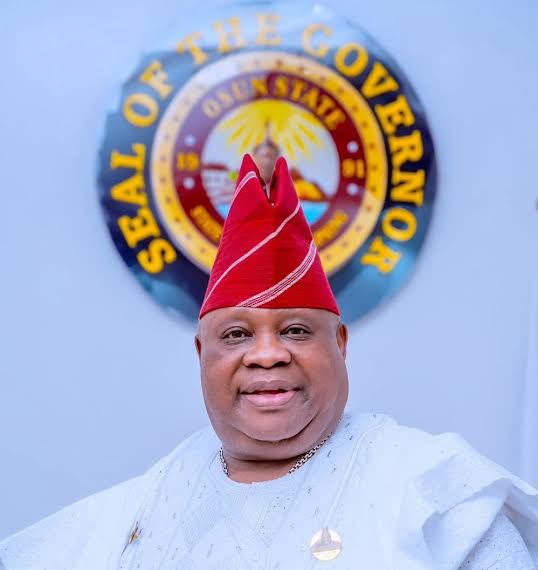
Governor Ademola Adeleke of Osun State has come under renewed public scrutiny following his appearance at the inauguration of President Bola Tinubu’s campaign council and his declaration of support for the president’s re-election bid, with questions emerging over what the political alignment could mean for the state.
In a commentary, Adejare Ayokanmi Olamide argued that Adeleke’s decision should be assessed beyond party loyalty and political sentiments, particularly if the engagement could help address challenges affecting governance and development in Osun.
Adejare acknowledged that the governor’s appearance attracted mixed reactions, with some supporters viewing it as political maturity and an opportunity for negotiation, while others saw it as a departure from the political struggles that brought Adeleke to power.
He argued that political cooperation does not necessarily amount to surrender, noting that leaders sometimes have to engage those with whom they have disagreements in pursuit of broader public interests.
According to him, the key question should be whether Adeleke’s relationship with Tinubu can translate into tangible benefits for the people of Osun State.
The commentary also traced the Adeleke family’s political history to the late Senator Isiaka Adetunji Adeleke, popularly known as Serubawon, whose political legacy helped establish the family’s longstanding presence in the state.
It highlighted Adeleke’s political journey, including the 2017 Osun West senatorial by-election and his governorship contests in 2018 and 2022, when he defeated then-governor Gboyega Oyetola.
Adejare said the political journey had involved intense competition and difficult experiences, arguing that such circumstances should be considered when examining the governor’s latest political decision.
He also pointed to workers’ welfare, pension payments, infrastructure and social support as areas supporters of Adeleke cite when assessing his administration’s performance.
One major issue raised in the commentary was the prolonged dispute surrounding local government administration, including access to local government funds and control of council secretariats.
Adejare argued that resolving such disputes through lawful means could improve the delivery of services at the grassroots level, adding that any political engagement should be judged by its practical effect on governance.
He also drew a comparison with the biblical account of Joseph, who chose reconciliation with his brothers after being betrayed, using the story to illustrate how forgiveness and a sense of responsibility can sometimes take precedence over personal grievances.
However, the commentary acknowledged that Adeleke’s supporters have legitimate reasons to seek clarity about his political alignment, particularly those who stood by him through previous electoral battles.
It maintained that the governor should explain how his decision aligns with his commitments to the people, while supporters should be able to assess the engagement critically rather than through party loyalty alone.
Adejare concluded that Adeleke’s support for Tinubu should not be judged solely by reactions at political gatherings or on social media, but by whether it produces measurable benefits for Osun State.
He said the people ultimately deserve a government that protects public resources, improves healthcare and education, supports vulnerable residents and delivers on its development promises.
“The question that matters most remains this: What does this decision mean for the people of Osun State?” he asked, stressing that the success of any political engagement would depend on its outcomes rather than its symbolism.
What do you feel about this post?

Like

Love

Happy

Haha

Sad