

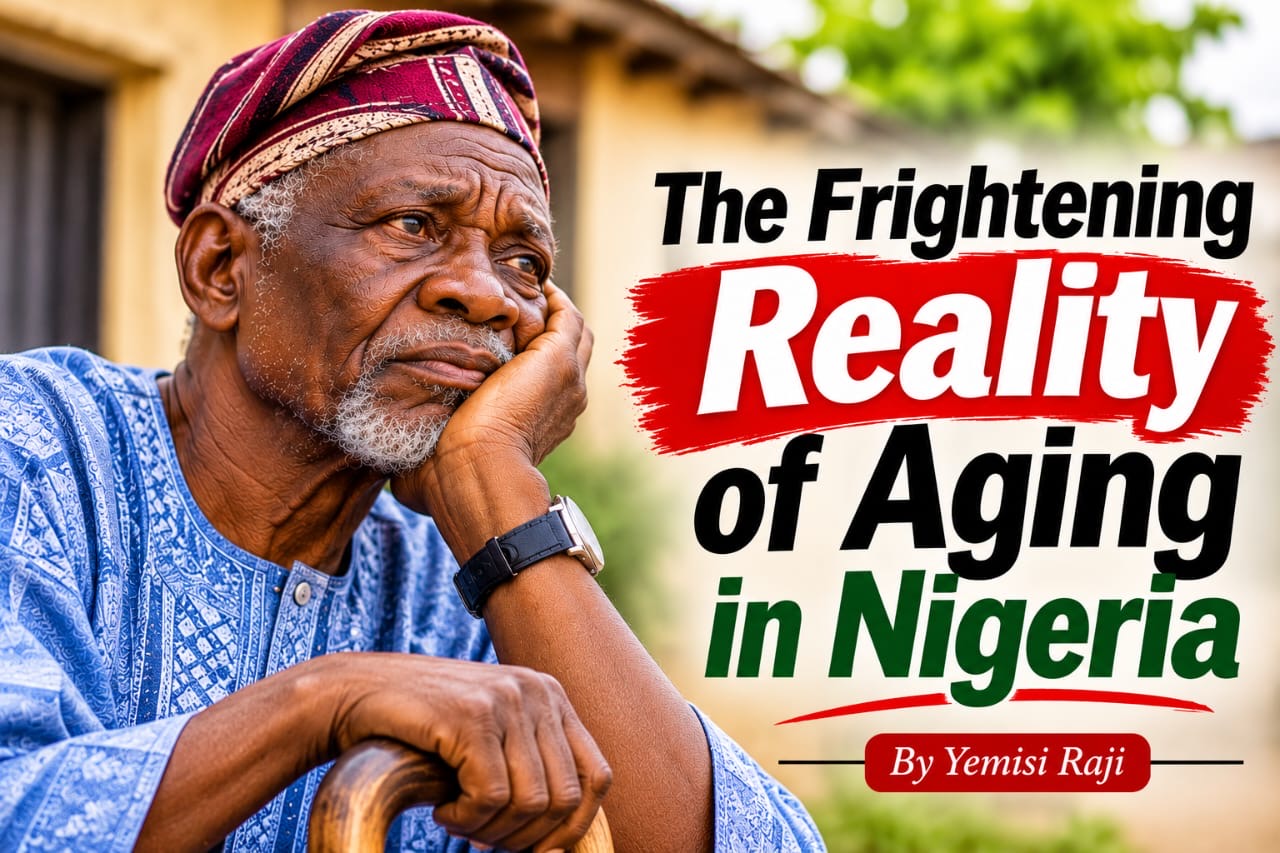
Growing old in Nigeria is quietly becoming frightening. Everyone seem to be getting busier but less connected.
It is now normal to live in a house full of people and still feel alone. You can have children, relatives, neighbours and even people who call you regularly, yet have nobody to sit with when silence becomes unbearable.
For many older Nigerians, loneliness is becoming an uncomfortable reality, though It is a subject we avoid.
In this part of the world, culturally, we believe that old age comes with a guaranteed reward: children who will care for their parents, relatives who will gather around them, neighbours who will check in and a community that will never allow an elderly person to feel abandoned.
But is that still the reality?
In Nigeria, we celebrate family. We talk about the importance of having children, respecting elders and taking care of our parents. We remind young people that the sacrifices their parents made must never be forgotten. Yet, somewhere between the struggle to survive, the demands of modern life and the changing structure of families, a lot of elderly people are quietly being left behind.
Loneliness is slowly becoming the order of the day and it does not always announce itself.
These days we see an elderly man sitting alone in the sitting room, watching television not because the programme interests him, but because it gives him something to listen to. Or an older woman who keeps calling her children, not necessarily because she has an urgent need, but because hearing their voices is the closest thing she has to companionship.
Sometimes, it is the parent who says, “I’m fine. Don’t worry about me,” even when what they really want to say is, “I wish you had more time for me.”
The children have left home and life has moved on.
The Nigerian family structure is changing.
Years ago, it was common for extended families to live close to one another. Grandparents, uncles, aunties, cousins and grandchildren often shared homes or neighbourhoods. There was usually somebody around to talk to, somebody to send on an errand and somebody to notice when an elderly person had not come out of their room.
Today, things are different.
Children move from their hometowns to other parts of the country in search of better opportunities. Others relocate abroad, pursuing careers, education and a more comfortable life.
Some have demanding jobs, young families, financial responsibilities and their own struggles to manage.
The distance is not always physical. Sometimes, children live in the same city but hardly have time to visit.
A phone call becomes a substitute for presence. A monthly allowance becomes a substitute for care. A WhatsApp message becomes evidence that somebody has checked in.
Of course, there is nothing wrong with children building their lives. Parents should want their children to succeed. But somewhere along the way, we must ask ourselves: have we become so occupied with building our own lives that we have forgotten the people who helped us get here?
An elderly parent may not need another transfer. Sometimes, they need someone to sit beside them, ask how their day went and genuinely listen to the answer.
Money can pay for medication, food and electricity. It cannot always replace human presence.
One of the hardest parts of growing old is adjusting to the absence of the life you once knew.
The children who filled the house have grown up. The friends who visited regularly are no longer around. Some siblings and relatives have passed away. A spouse may have died, leaving behind years of shared memories and a silence that no new relationship can easily fill.
For a widow or widower, loneliness can be particularly painful.
Imagine spending decades sharing meals, discussing everyday problems, making plans and building a life with someone, only to wake up one morning and realise that the person you expected to grow old with is no longer there.
The empty chair at the dining table becomes a reminder. Nights become longer. Even ordinary decisions can feel overwhelming when there is nobody to discuss them with.
And while people may offer condolences and visit during the burial, the attention gradually fades. Life returns to normal for everyone else, but the bereaved person must learn to live with a new normal.
We are often present for people’s funerals, but are we present for their loneliness afterwards?
When we talk about ageing, the conversation usually revolves around physical health. We discuss blood pressure, diabetes, arthritis, mobility, medication and regular medical check-ups.
These are important, but emotional well-being deserves the same attention.
An older person can be physically healthy and emotionally struggling. They may have food in the kitchen, a comfortable bed and a roof over their head, yet feel disconnected from the world.
Some elderly people become withdrawn. Others become irritable or unusually demanding. Some call frequently, complain about being forgotten or insist on being involved in conversations that younger family members consider unimportant.
Rather than dismissing these behaviours as old-age stubbornness, perhaps we should pause and ask what lies beneath them.
Could it be boredom? A need for attention? Fear of being irrelevant? The frustration of losing independence? Or simply the desire to feel that they still matter?
Growing old means confronting changes that are not always easy to accept. The person who once provided for everybody now needs assistance. The parent who made all the decisions now has to depend on others. The person who once commanded a room now feels that nobody listens to them anymore.
There is a particular kind of loneliness that comes from feeling that the world has moved on without you.
As Nigerians, we are often proud of our respect for elders. We teach children to greet older people properly, offer them seats and speak to them with courtesy.
But respect should be more than a greeting.
It should mean paying attention. It should mean making time. It should mean recognising that older people have emotional needs, personal interests and a desire to remain active participants in life.
An elderly person is not simply somebody to be tolerated because of their age. They are individuals with memories, opinions, humour, fears, dreams and a continuing need for connection.
We should also challenge the assumption that every elderly person is surrounded by loving family members. Some have no children. Some are estranged from their children. Some have outlived most of their relatives. Others have families who are unable or unwilling to provide the support they need.
For these people, the loneliness can be even more complicated.
And it is not enough to tell them to pray, be patient or accept their situation. Faith can provide comfort, but people also need companionship, practical support and opportunities to participate in everyday life.
There is another uncomfortable issue we need to confront: how society treats people when they become less productive.
In a society where survival is a daily struggle, caregiving can become financially and emotionally demanding. Families are dealing with school fees, rent, business expenses, unemployment, inflation and the cost of healthcare. Adding the responsibility of caring for an ageing parent can stretch already limited resources.
But we must be careful not to turn this reality into an excuse for neglect.
Caring for an elderly person should not be reduced to feeding them, paying their bills or providing somewhere to sleep. They need dignity. They need patience. They need to be included in family life.
And caregiving should not only be left to one person, usually a daughter, wife or female relative, while everyone else assumes that the responsibility will somehow be handled.
Families need to have honest conversations about sharing the financial, physical and emotional demands of care.
We also need stronger community support systems, accessible healthcare, responsible caregiving services and social spaces where older people can interact, learn, participate and feel useful.
Not every elderly person needs to spend their final years waiting for a family member to visit.
Perhaps the solution begins with changing how we see old age.
We should stop treating ageing as though it automatically means the end of usefulness, adventure, friendship, romance or personal fulfilment.
Older people still need friendships. They still need laughter. They may want to learn something new, attend social gatherings, worship with others, travel, exercise or simply have somebody to share a cup of tea with.
A visit should not always be prompted by illness or an emergency. A telephone call should not always begin with, “What do you need?”
Sometimes, call just to gist.
Ask about their memories. Ask what they think about current affairs. Invite them to family events. Let them tell their stories, even if you have heard them before. Teach them how to use technology without making them feel foolish. Help them maintain friendships and interests outside the family.
And if you are fortunate enough to have your parents around, remember that their need for connection does not disappear because they are no longer responsible for your everyday needs.
Equally, we must create a society where people can build meaningful relationships beyond their immediate families. Community centres, religious organisations, neighbourhood groups and social clubs can play an important role in ensuring that older people are not isolated.
Growing old should not mean disappearing from society.
Growing old is an eventuality for everyone, if we’re lucky.
You become the parent waiting for a phone call, the grandparent hoping for a visit, the widow and widower learning to live with an empty house, or the older neighbour watching the world become unfamiliar.
The people we overlook today may be a reflection of the people we will become tomorrow.
So perhaps the question is not whether we are taking care of our elderly relatives, It is whether we are creating a society in which people can grow old without feeling forgotten.
Because loneliness is not always about having nobody around. Sometimes, it is about having nobody who truly makes time for you.
And perhaps the greatest fear of growing old is not the wrinkles, the grey hair, the slowing body or even the thought of death.
It is the possibility of living long enough to feel that you no longer matter to anyone.
We cannot stop time from ageing us, but we can stop loneliness from becoming the price people pay for growing old.
Yemisi Raji (TiwaSays)
Subscribe to my YouTube channel: @tiwasays_Diaries
Follow me on Tiktok @tiwasaysll
Send me a message on Telegram at: @tiwa_says;
WhatsApp: 09161129108; and Email: [email protected].
What do you feel about this post?

Like

Love

Happy

Haha

Sad